
Back
Checkout Optimization for Guess
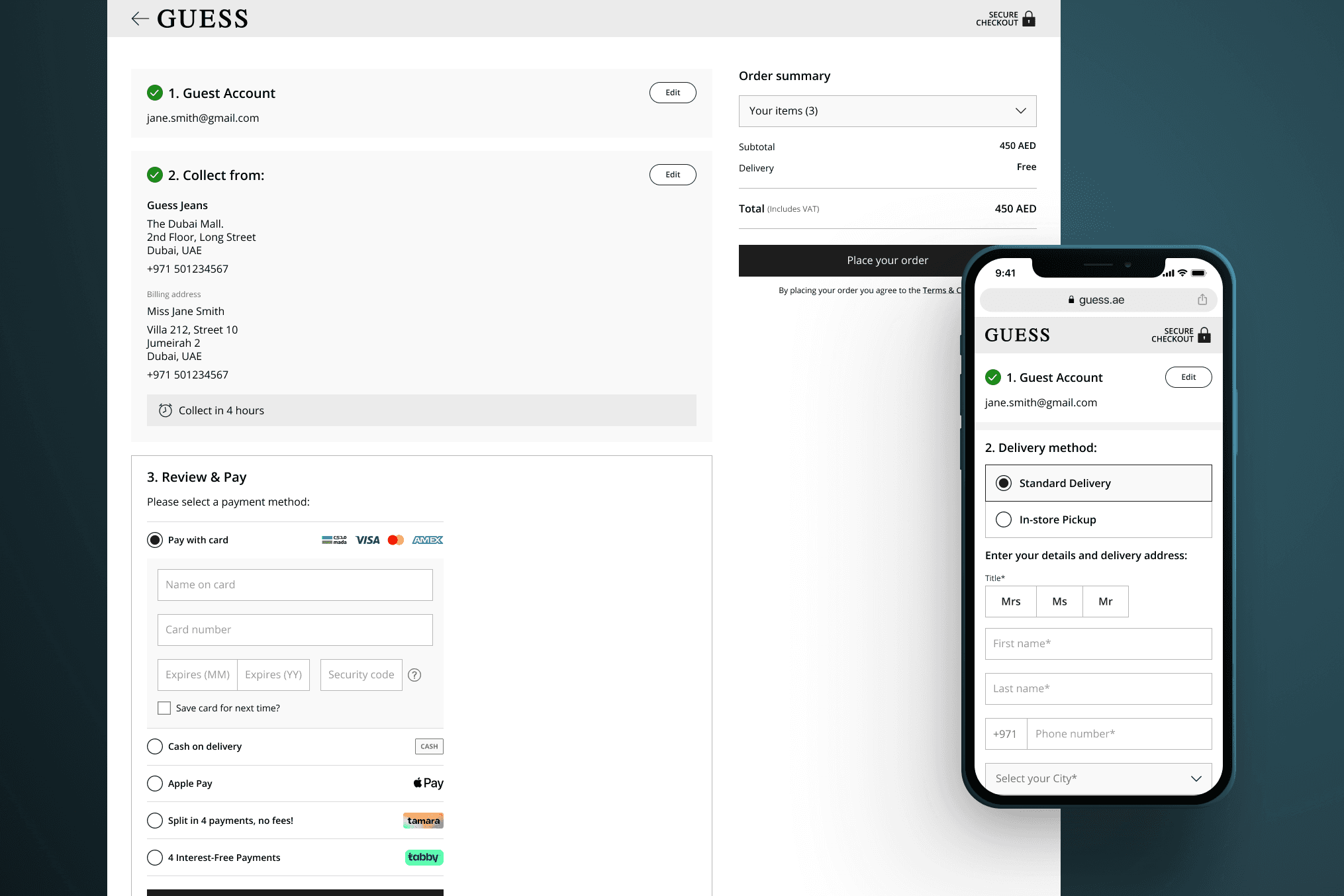
Redesigned the checkout flow to reduce friction and increase purchase completion.

Role
UX Designer
Team
Product managers and developers
Timeline
Feature redesign
Company
Guess
Scope
UX Designer
Goal
Product managers and developers
As a Baymard certified designer, I applied insights from over 80,000 hours of e-commerce usability research to redesign the checkout experience and reduce common friction points.
The Problem
Checkout is one of the most critical steps in the e-commerce funnel. Even small usability issues can cause significant drop-off.
Common issues identified in the existing checkout included:
unclear form hierarchy
unnecessary cognitive load during checkout
friction in the payment step
limited reassurance signals during the purchase process
These issues increased abandonment and slowed down the purchase flow.
Research
The redesign was informed by best practices from Baymard Institute, which is based on extensive usability testing across major e-commerce platforms.
Key research insights:
Simplifying form structure reduces abandonment
Clear progress indicators improve completion rates
Payment reassurance messaging increases trust
Reducing unnecessary fields improves checkout speed
Design Decisions
Simplified Form Structure
Fields were reorganized into a clearer hierarchy to reduce cognitive load.
Improved Payment Clarity
Payment methods were presented more clearly with visual grouping and clearer labels.
Trust and Reassurance
Security and payment reassurance messaging was introduced at key decision points.
Better Error Handling
Improved inline validation to help users quickly correct mistakes.
Key UX Improvements
Examples of improvements you can show visually:
redesigned form hierarchy
clearer payment selection
improved order summary visibility
reduced visual clutter
Visuals to include:
Old checkout design
Redesigned checkout
Annotated improvements
Mobile checkout layout
Results
The redesigned checkout delivered measurable improvements.
Impact
18% increase in checkout conversion
reduced checkout friction
faster purchase completion
This demonstrates how applying established e-commerce usability principles can directly improve revenue performance.
Reflection
Future improvements could include:
progressive disclosure for advanced fields
personalized payment options
checkout A/B testing to further optimize conversion